Articulation Warm-Ups
What this lesson changes, and why it works.
1.Lesson introduction
Your mouth is a set of muscles, and like any muscles they work better warm. Speakers who mumble in the first ten minutes of a meeting are usually not unclear people — they are cold. This routine takes five minutes and can be done in a car, a stairwell or at a desk. Nothing here should hurt; every movement is gentle and repeatable.
2.Learning objectives
- Run the five-minute routine and the 60-Second Reset from memory
- Move the jaw, lips and tongue independently
- Use the Mee–May–Mah–Moh–Moo and Pa–Ba–Ta–Da–Ka–Ga sequences
- Know where the lips and tongue sit for each family of sounds
3.Your clear-speech toolkit
Each lesson adds a layer. By the final lesson the whole stack is working at once.
- Your Lesson 1 recording— covered in an earlier lesson
- Breath and physical ease— covered in an earlier lesson
- Today: Articulation warm-up— this lesson
4.Narrated audio lesson
Welcome
Lesson 3: Articulation Warm-Ups
Welcome to lesson 3, Articulation Warm-Ups. Your mouth is a set of muscles, and like any muscles they work better warm. Speakers who mumble in the first ten minutes of a meeting are usually not unclear people — they are cold. This routine takes five minutes and can be done in a car, a stairwell or at a desk. Nothing here should hurt; every movement is gentle and repeatable.
5.How it works
Lips: P, B, M and W are built here. The lips must actually close and release — a lazy near-close is what blurs these sounds.
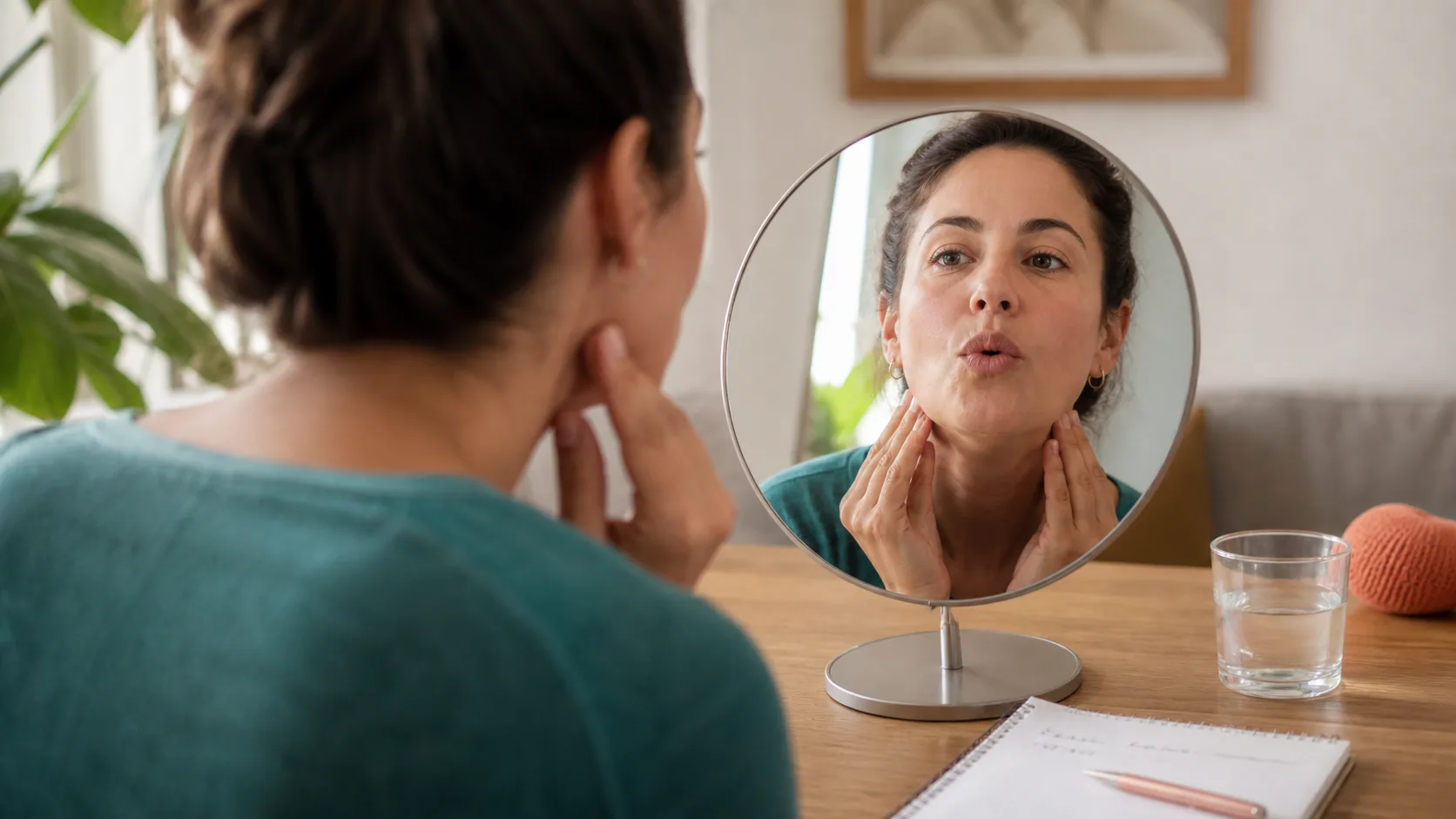
The same thing on a real body — copy the shape, not the setting.
- 10:00–0:45 Gentle jaw release — let the jaw drop, small easy circles, no clicking or forcing.
- 20:45–1:30 Lip rounding and smiling — 'ooo' to 'eee', ten slow alternations.
- 31:30–2:15 Tongue side to side — touch each corner of the mouth, then behind the top teeth.
- 42:15–3:00 Lip trills (brrrr) if comfortable — skip if it feels awkward, hum instead.
- 53:00–4:00 Mee–May–Mah–Moh–Moo, three rounds, slow then normal.
- 64:00–5:00 Pa–Ba–Ta–Da–Ka–Ga, three rounds, crisp and light.
Where the sound is made
Lips: P, B, M, W. Tongue tip behind the top teeth: T, D, N, L. Back of the tongue: K, G. Watch the animated guide and mirror it.